
Self-help fails for a boring reason. People collect advice. They do not install it.
BetterThisFacts tips by BetterThisWorld only help if a tip survives a messy Wednesday. Not a quiet Sunday. Not a fresh notebook. A normal day with messages, meals, and a tired brain.
This article does not repeat a facts-and-figures dump. That job belongs on the facts page. This page is the workshop.
- You pick one move.
- You give it a home in your day.
- You keep it for 14 days.
I use the same test I use on process docs for teams: if a junior hire cannot do the step without a pep talk, the tip is still a slogan.
What these tips are for
Betterthisfacts tips by betterthisworld are installation notes.
- They assume you already believe small changes beat makeovers.
- They are for people who have tried January plans and watched them die by the second week.
- They are not a new philosophy. They are placement, timing, and friction.
A tip has a job when you can answer four questions:
- Where does this happen?
- What starts it?
- What ends it?
- How will I know it ran?
If you cannot answer those, you do not have a habit. You have a wish.
Why most tips collapse by day four
Willpower is a bad operating system. It works before 9 a.m. It fails after a bad meeting.
Three failure modes show up again and again.
The tip is too big. “Get fit” is not a tip. “Walk after dishes” is.
The tip has no cue. “Be more present” needs a doorbell in your day. No cue, no repeat.
The tip fights the room. If the snack is on the counter and the kettle is in a closed cupboard, the room already voted.
Betterthisfacts tips from betterthisworld should redesign the room first. Motivation can arrive later, or not at all.
The 14-day install method
Use this method for every tip below. Do not run five tips at once.
- Choose one tip only.
- Write the cue in one line: “After I ____, I ____.”
- Shrink the first version so it takes under two minutes.
- Put a visible mark on a calendar.
- Missed a day? Restart the next cue. Do not write a confession essay.
- On day 14, keep it, shrink it, or drop it.
That is the whole system.
A real example. After I shut my laptop, I place the water bottle on the desk for tomorrow. That is not wellness theater. It is a setup move. Morning-you inherits an easier start.
Tip 1: Attach the new act to a finished act
Do not schedule a habit in empty space. Glue it to something you already finish.
After I pour coffee, I write three outcomes.
>After I lock the door, I put keys on the hook.
>After I plate dinner, I put the phone in a drawer.
This is an implementation intention. The cue is the last step of a current routine. The new act rides along.
Keep the add-on smaller than the host habit. If dinner takes 20 minutes, the phone move takes 10 seconds. The host habit can carry that.
Tip 2: Make the first step insultingly small
People quit because they start at chapter seven.
- Want a reading habit? Open the book and read one page.
- Want a stretch habit? Touch your toes once.
- Want a money habit? Open the banking app and look at yesterday.
The first step is a permission slip. You can continue. You do not have to.
I have watched operators fail a “30-minute writing block” and succeed at “open the doc and write the ugly title.” Same person. Different door size.
Tip 3: Move the friction, do not lecture yourself
Every habit has a cost. You either pay it at the start or you hide the cost.
- If you want fewer night snacks, put them on a high shelf in a closed box.
- If you want morning movement, sleep in the clothes you will walk in.
- If you want less scrolling, log out of the worst app every night.
You are not becoming a better person in the abstract. Also, you are changing the number of steps between you and the action.
When I audit a workspace, I look at desks, not values posters. The desk tells the truth.
Tip 4: Protect a start window, not a whole day
A full-day overhaul is a fantasy schedule. A 15-minute start window is a tool.
Pick one window:
- First 15 minutes after waking
- First 15 minutes after lunch
- Last 15 minutes before bed
Give that window one job. Not three.
Morning window: water, light, three outcomes.
Lunch window: walk or stretch.
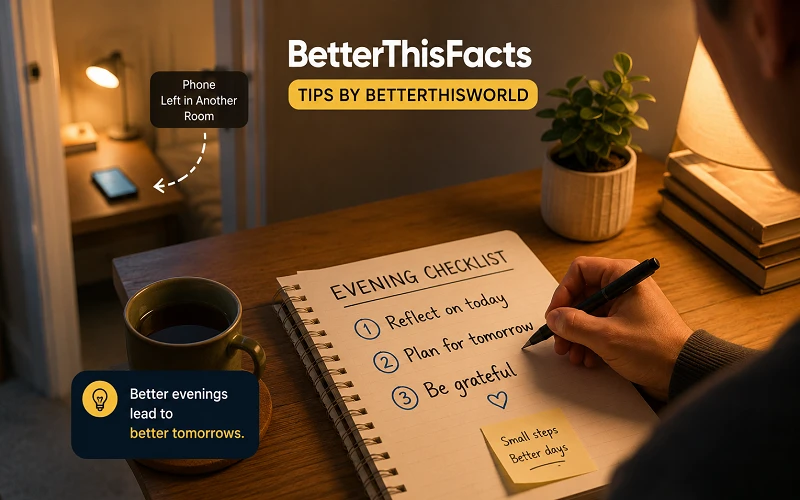
Night window: bag packed, phone charged elsewhere, one “done” line.
The rest of the day can stay messy. The window still counts.
Tip 5: Use a two-list close for money anxiety
Money panic often comes from blur, not from a missing investment thesis.
Once a week, write two lists.
List A: money that arrived.
List B: money that left.
No color coding. No new app in week one. A note on your phone is enough.
Circle anything on List B that surprised you. That circle is the next decision, not a character review.
This tip belongs here because it is a habit, not a market forecast. Deep money frameworks live on the money page. This is only the weekly close.
Tip 6: Put unfinished work in a parking lot
Open loops steal evenings. Your brain rehearses them because it does not trust a capture system.
Keep one note called “Parking.” When a task pops up during dinner or a walk, park one line. Not a plan. A line.
“Email Sam the file.”
“Buy tape.”
“Check invoice 18.”
Then return to the thing you were doing.
Review the parking lot at a set time, not every time a thought appears. I use the last 10 minutes at the desk. If you review all day, the list becomes another feed.
Tip 7: Decide clothes, food, and deep work the night before
Decision fatigue is real enough to respect. You do not need a lab coat to see it. Late-day you makes worse calls.
Night-you can pre-decide three things:
- What you will wear
- What lunch is
- What the first deep task is
Morning-you executes. That is a kinder contract.
If night-you is exhausted, pre-decide only the first task. One decision still beats a blank morning.
Tip 8: Build a “good enough” workout that can happen in a hallway
A gym plan that needs a bag, a commute, and a perfect mood will lose to the couch.
Write a hallway version:
- 20 bodyweight squats
- 10 wall push-ups
- 30-second plank
- Walk the stairs twice
That set can happen between calls. It does not replace training if you already train. It exists for the days training would otherwise be zero.
Zero to hallway is a bigger jump than hallway to gym.
Tip 9: Make social default work for you
People copy the room. If your group eats late, you eat late. If your chat pings all night, you answer all night.
You do not need new friends this month. You need one default change.
Examples:
- Suggest a walk meeting instead of a coffee meeting once a week
- Put group chats on mute after 9 p.m.
- Tell one person your 14-day tip so they can ask “did it run?”
Accountability is not a public announcement. It is one human who knows the cue.
Tip 10: End the day with a close, not a verdict
A verdict sounds like “I wasted today.” A close sounds like “Here is what finished. Here is the first move tomorrow.”
Write two lines at shutdown:
- Done: ____
- First move tomorrow: ____
Then stop negotiating with the day.
This close prevents the evening spiral where you replay missed items and call it planning. Planning already happened in two lines.
A weekly rhythm that does not eat the weekend
Use one short review. Ten minutes. Same weekday.
Ask only this:
- Which tip ran at least 5 days?
- Which cue failed?
- Do I keep, shrink, or drop it?
If it ran 5 days, keep it and add nothing.
>If it ran 2 days, shrink the first step.
>If it ran 0 days, the cue is wrong. Change the hook, not your personality.
Betterthisfacts tips by betterthisworld should produce a calendar with marks, not a mood.
What to skip so this page stays unique
Do not turn this page into another encyclopedia of public statistics. Readers who want sleep percentages, phone-check averages, and savings rates should use the facts-and-figures article.
Do not mix gaming tricks, stock picks, and cosmos posts into these tips. Those topics need their own homes. Mixing them is how pages compete and all lose.
Do not stack ten tips in week one. Stacking is how this article becomes as useless as a listicle you screenshot and forget.
Two worked examples
Example A: The late-night scroller
Cue that failed: “I will scroll less.”
New cue: After I plug in the kettle at night, I plug the phone in the kitchen.
First version: phone stays in the kitchen until the alarm the next morning. A $8 clock takes the alarm job.
Day 14 check: Did kitchen charging happen 10 nights? If yes, keep it. Do not add a 5 a.m. journal yet.
Example B: The person who never starts deep work
Cue that failed: “I will focus more.”
New cue: After I sit down with coffee, I open one document and write the ugly title.
First version: five minutes. Timer visible.
Day 14 check: Did the file open before email on workdays? If yes, extend to 15 minutes. If no, open the file the night before and leave it full screen.
Both examples change placement. Neither requires a new identity.
Common questions
How many BetterThisFacts tips by BetterThisWorld should I run at once?
One. After 14 clean days, you may add a second. Two is the ceiling for most working weeks.
What if I miss three days?
Misses are data. The cue is too weak or the step is too big. Rewrite “After I ____, I ____.” Do not add punishment workouts.
Do I need an app?
No. A paper calendar outperforms a streak app you stop opening. Use an app only if it already sits in your path.
How is this different from the facts page?
The facts page shows numbers and sources. This page shows where to stand and what to touch. Read facts when you need a baseline. Use this page when you need a cue.
Conclusion
BetterThisFacts tips by BetterThisWorld work when they live in a doorway, a charger, a kettle, and a two-line close. They fail when they live in a saved tab.
Pick one tip. Write the after-then sentence. Shrink it until it feels almost too small. Mark 14 days.
If the tip still runs on a bad Wednesday, keep it. That is the only review that matters.
When you want numbers and sources next, open the facts-and-figures page. When you want cash rules after the weekly two-list habit is stable, open the money page. Keep each URL on one job.