
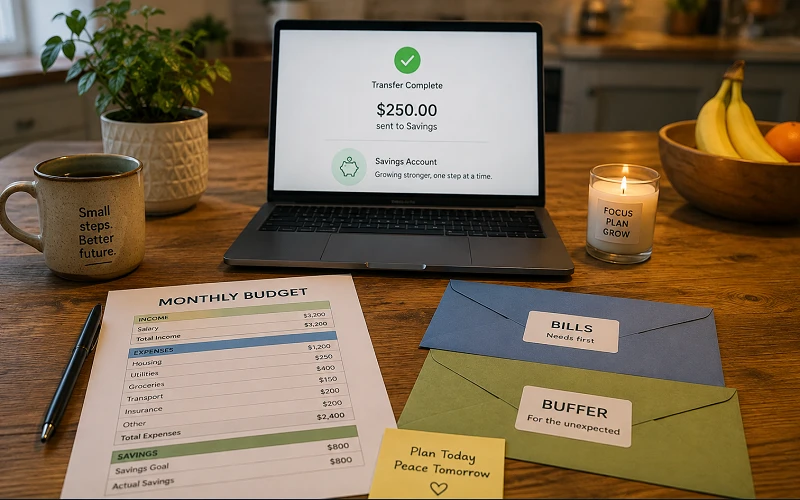
Most money writing starts at the exciting end. Tickers. Side hustles. “Mindset.”
Your week does not start there. It starts with rent, food, transport, and a charge you forgot.
BetterThisWorld Money is a cash-first plan. You see the week. You build a floor and cut the debt that bites. Only then do you touch markets or a business offer.
This is not the facts page. That page lists public figures. This page builds a working order for your pay cycle.
This is not the tips page. That page installs tiny habits. This page assigns dollars to jobs.
I use the same rule I use when I review a freelancer’s books: if the plan needs a perfect month, it is not a plan.
What BetterThisWorld Money is not
Money betterthisworld content goes wrong when it pretends a slogan is a system.
>It is not a get-rich script.
>It is not a stock hotlist.
>It is not a demand that you enjoy spreadsheets.
It is a sequence:
- Visibility
- Buffer
- Costly debt
- Simple investing
- A cleaner offer if you sell work
Skip a rung and the next one wobbles. People buy a trading app while a $38 subscription still leaks every month. The app feels like progress. The leak is the real story.
The payday order
Run money in this order. Do not remix it because a video sounded smarter.
This payday: move a small amount to a buffer account before you browse.
This week: write seven days of money in and money out.
This month: pick one extra debt payment or one cut.
This quarter: if the buffer holds, automate a boring investment.
Write the order on a note. When a new idea arrives — crypto, a course, a “system” — ask which rung it serves. If it serves none, it waits.
Step 1: Give every incoming dollar a job
You cannot manage what you refuse to see.
For seven days, capture three fields only:
- Date
- Amount
- Job of that money
Jobs are short: rent, food, ride, tool, fun, debt, buffer.
Do this on paper if apps make you hide. The tool does not matter. The seven days do.
At the end of the week, circle three outflows that surprised you. Those circles are your first cuts or your first honest categories.
A client I advised swore he had a “discipline problem.” The week showed four tools billing for seats he no longer used. We cancelled two before we talked about index funds. His mood changed faster than any quote about abundance.
Step 2: Build a floor before you build a story
A floor is cash you can reach in one business day. No shares. Not crypto. Not money you already promised to a card.
Name your floor in this order:
- $500
- $1,000
- One month of must-pay costs
- Three months only after the first three exist
Must-pay costs means housing, utilities, food, transport, insurance, minimum debt payments. It does not mean your ideal lifestyle.
If your must-pay total is $2,400, one month is $2,400. That number is more useful than a generic “3–6 months” chant.
Park the floor in a separate account. Label it “floor.” Do not label it “opportunities.” Labels change behavior.
Automate the transfer on payday, even if the amount looks small. $15 that leaves every payday beats $200 you intend after a “good month.”
Two sample months so the math gets specific
Use these as patterns. Swap in your rent and your city.
Sample A: $2,500 take-home
| Job | Amount | Rule |
|---|---|---|
| Housing + utilities | $1,100 | Pay first |
| Food | $400 | Cook 10 meals at home |
| Transport | $180 | Cap rideshare |
| Minimum debt | $220 | Never skip |
| Buffer transfer | $80 | Same day as payday |
| Tools / phone | $120 | Audit on the 1st |
| Flexible | $400 | If it hits zero, stop |
This month is tight. The win is the $80 floor transfer, not a heroic savings rate you will abandon.
Sample B: $5,000 take-home
| Job | Amount | Rule |
|---|---|---|
| Housing + utilities | $1,600 | Pay first |
| Food | $550 | Keep takeout to 4 meals |
| Transport | $250 | |
| Minimum debt | $300 | |
| Buffer transfer | $400 | Until one month is full |
| Tools / phone | $150 | |
| Giving or family help | $150 | Optional, planned |
| Flexible | $800 | |
| Next-rung investing | $200 | Only after $1,000 floor exists |
Notice investing sits last. Betterthisworld money stays honest when the portfolio does not eat the floor.
Step 3: Attack the debt that charges you for waiting
All debt is not equal. A 22% card and a 4% installment loan are different animals.
Use one extra payment at a time.
Avalanche: extra cash goes to the highest interest rate. Best math.
Snowball: extra cash goes to the smallest balance. Best for visible wins.
Pick one. Write the name of the target account on a card. Every extra dollar this month goes there. Not to a new “debt system.” To that account.
A simple compare:
| Method | You target first | Best when |
|---|---|---|
| Avalanche | Highest APR | You can stand slow visible progress |
| Snowball | Smallest balance | You need a closed account for momentum |
Do not refinance as a hobby. Refinance when the new rate is lower, the fee is clear, and you will not use the old card to refill the balance.
While you pay extra, keep minimums current on everything else. Missed minimums erase clever strategy.
Step 4: Stocks BetterThisWorld should mean ownership, not a hobby feed
Searches for betterthisworld stocks and stocks betterthisworld often come from a person who saw a ticker and felt late.
Slow down.
A stock is a slice of a business. If you cannot say how that business earns cash in two sentences, you are not investing. You are placing a side bet.
For most people who still work for a paycheck, the first market product should be dull:
- A low-cost broad fund
- Automatic buys
- A time horizon measured in years
- Money that is not next month’s rent
Single-company picks can wait until the floor is funded and the high-APR balance is falling. Even then, a single name should be a small slice, not the plan.
Questions that keep you out of trouble:
- When will I need this money?
- What fee do I pay each year?
- What happens if this drops 30% and I still need groceries?
If the answer to the last question is “I would sell in a panic,” the money is not ready for markets.
This page will not hand you tickers. That would be theater. Stocks betterthisworld coverage is useful as a glossary and a gate, not as a buy list.
Step 5: BetterThisWorld business starts with a one-page offer
Betterthisworld business advice should shrink, not decorate.
If you sell work, write one page with four lines:
- Who pays?
- Why do they pay now?
- What does it cost you to deliver?
- What remains after tools, ads, and tax?
If you cannot fill the four lines, a new logo will not help.
A worked sketch:
- Who pays: local clinic managers who book their own staff.
- Why now: they lost two no-shows last month.
- Cost to deliver: three hours plus a $12 tool.
- What remains: price $450, costs $60, tax set-aside 25%, rest is yours.
Sell that once. Then decide if a second product exists. Do not build a funnel for an offer you have never sold.
I have seen owners spend six weeks on brand kits and skip a $1,500 diagnostic call that two people would have bought this month. The call is the business. The kit is costume.
A 30-day BetterThisWorld Money sprint
This sprint is a calendar, not a personality reset.
Days 1–7: Capture inflows and outflows. No optimization speeches.
Days 8–10: Write must-pay costs. Set the floor target. Open or label the floor account.
Days 11–15: Cancel or pause one leak. Move the first automated buffer amount.
Days 16–22: Choose avalanche or snowball. Make one extra payment, even a small one.
Days 23–26: If you sell work, draft the four-line offer. Send it to one real person.
Days 27–30: Review the month in one sitting. Keep one automation. Drop one idea that did not serve a rung.
At day 30 you should have artifacts: a week of numbers, a labeled account, one cut, one extra payment or one sent offer. Feelings are optional.
Guardrails that save the plan
Write these where you see them on payday.
- Buffer leaves the checking account the same day income arrives.
- No new tool until an old tool dies.
- No market buy with money you need inside 12 months.
- No second credit product while you still carry 20%+ balances.
- No “business spend” that does not appear on the four-line offer.
Guardrails sound strict. They are cheaper than a reset every March.
How this page should connect to the others
Keep the jobs separate so the URLs stop fighting.
- Facts page: public numbers and sources.
- Tips page: cues and 14-day installs.
- This page: dollars, debt, markets as a later rung, offers.
If you want a weekly two-list close, use the tips page for the habit and this page for what the lists mean. Do not copy the same section into both.
If you later add a tech article, let it handle tools and security. Do not turn this money page into software reviews.
FAQ
What is BetterThisWorld Money in one sentence?
A cash-first sequence: see the week, fund a floor, cut costly debt, then invest or sell work with a clear offer.
How is money betterthisworld different from generic budgeting?
The difference is the order and the artifacts. You leave with a labeled floor, a target debt, and optional four-line offer. You do not leave with a mood.
Should I invest before my card is clear?
If the card charges high double-digit interest, extra payments usually beat market hope. A boring fund cannot outrun a 22% balance you keep feeding.
Do I need a business to use this plan?
No. Steps 1–4 work for a paycheck. Step 5 exists only if you sell something.
When do I move from buffer to stocks?
After you can reach one month of must-pay costs without a card, and after the high-APR extra payments are a routine. Then automate a small, broad, long-horizon buy.
Conclusion
BetterThisWorld Money is not a personality. It is a payday order. See the week. Name the floor. Cut the leak. Pay the expensive balance. Then, and only then, buy broad markets or sell a cleaner offer.
Take one step this payday. Move a small amount to the floor account before you open anything that looks like a tip.
When the floor has a balance you can point at, come back and run the next rung. That is how money betterthisworld stays useful instead of turning into another tab you meant to finish.