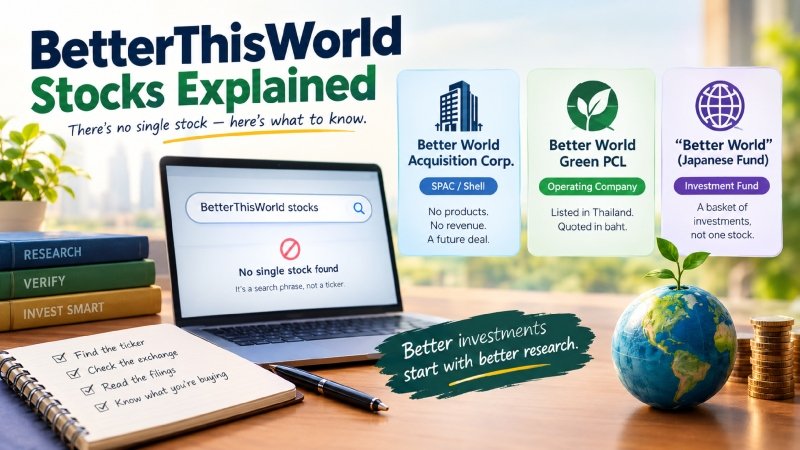
You search “BetterThisWorld stocks,” expecting a ticker, a price, and a clear yes or no. What you get instead is a tangle of near-matches, and that gap between what you typed and what exists is where careless investors lose money.
Here is what the search actually turns up. There is Better World Acquisition Corp., a blank-check company founded in 2020 and based in New York, which one data provider flags as potentially delisted and possibly not actively trading. There is Better World Green PCL, quoted in Thai baht, a separate operating company in a different market. And there is a Japanese unit trust nicknamed “Better World” that invests through a global impact-investing fund. A shell company, a business, and a fund: three different things sharing one phrase.
So the direct answer is this: there is no single, confirmed stock called “BetterThisWorld.” The name is a search phrase, not a ticker. In this guide, you’ll learn how to tell these look-alikes apart, how to verify any company before you invest, and how to pursue a “better world” theme without buying the wrong thing.
Why a Name Alone Is Never Enough
Most people treat a company name like an address. Type it in, arrive at the right place. Stock markets don’t work that way.
The only reliable identifier for a listed security is its ticker symbol combined with the exchange it trades on. Company names, by contrast, are marketing. They get reused, abbreviated, and borrowed across countries. Two firms can share nearly identical names and have no connection at all: different owners, different regulators, different currencies, different risks.
This is especially true for names built from warm, positive words like “better,” “world,” or “future.” They feel like a mission statement, and that feeling can quietly replace the research you would normally do.
The Three “Better World” Entities, Compared
Understanding what each one actually is clears up most of the confusion.
1. Better World Acquisition Corp.: the shell company
This entity is what’s known as a special purpose acquisition company, often called a SPAC or blank-check company. It raises money from investors with the stated goal of merging with or acquiring another business later. It has no products, no customers, and no operating revenue of its own.
Buying into a company like this means you are betting on a deal that hasn’t happened yet, and on the judgment of the people who will pick the target. Outcomes can range widely. Some SPACs complete mergers, some are liquidated, and some linger for years. When a data provider marks a listing as potentially delisted or inactive, that is a signal to slow down and confirm its current status before doing anything.
2. Better World Green PCL: the operating company
This is a different type of investment entirely. It is a company listed in Thailand, with its price quoted in baht. Because it operates in another market, factors like local regulation, currency movement, and disclosure standards all matter in ways a U.S.-based investor may not be used to.
If you are comparing it to the entity above, remember you are comparing a real operating business with a shell. Their financial statements, risks, and the questions you should ask are completely different.
3. The Japanese “Better World” fund
This one isn’t a company at all. It is a pooled investment fund sold in Japan, which puts money into a global impact-investing strategy. When you hold a fund, you own a share of a basket of investments, not equity in a single firm. Fund returns depend on the manager’s strategy, the underlying holdings, fees, and, for foreign holdings, currency swings.
The takeaway
| Entity | What it is | Main thing to understand |
| Better World Acquisition Corp. | Blank-check shell | You’re betting on a future deal |
| Better World Green PCL | Operating company (Thailand) | Foreign market and currency risk |
| “Better World” Japanese fund | Pooled impact fund | You own a basket, not one stock |
None of these is interchangeable with the others, and none is confirmed to be “BetterThisWorld.”
Real Risks of Name Confusion
It might sound like a minor research hiccup. In practice, name confusion causes real damage.
Buying the wrong ticker. Trading apps often show several similar-looking results. A rushed click can put your money into an entirely different company than the one you meant.
Borrowed credibility. Promoters know that positive, cause-driven names attract attention. A hopeful-sounding brand can make an obscure, thinly traded stock seem more trustworthy than it is.
Outdated or mixed-up data. When several entities share a name, old pages and stale statistics for one often get attributed to another. A listing that stopped trading long ago can still have a page that looks current.
Misreading the story. Without knowing whether you’re looking at a shell, a business, or a fund, you may apply the wrong yardsticks and reach confident but wrong conclusions.
A Step-by-Step Verification Routine
Before committing money to any security you found through a name search, run through these steps.
- Find the ticker and the exchange. If you can’t state both, you haven’t identified the investment yet.
- Confirm the legal entity. Look up the registered company name, country of incorporation, and filing history in the official regulatory database for that market.
- Check that it actually trades. Look at recent trading volume. A listing with little or no activity can be hard to sell when you want out.
- Identify the type of security. Operating company, shell, fund, or something else? This decides how you analyze it.
- Read primary documents. Annual reports and official filings come directly from the company. Summaries on aggregator pages can be incomplete or mislabeled.
- Note the currency and market. A low-looking price in one currency may mean something very different from the same number in another.
- Compare against similar names. Deliberately look for look-alikes. If two entities share a name, make sure you know which one you’re looking at.
Reading the Warning Signs on Small Listings
Small and obscure listings aren’t automatically bad, but certain patterns call for extra caution:
- Very low trading volume and wide gaps between buying and selling prices
- Little or no revenue, with the story resting on a future announcement
- Heavy online promotion paired with few independent analyst reports
- Thin disclosure, or filings that are hard to locate
- Sudden bursts of social media attention with no matching business news
If several of these appear together, treat any position as money you can afford to lose entirely.
If You Want a “Better World” Theme in Your Portfolio
Many people who search this phrase aren’t really hunting for one company. They want investments that reflect positive social or environmental values. That’s a sensible goal, and there are better routes to it than guessing at a name.
Impact and sustainability funds. These pool money into companies chosen for measurable social or environmental outcomes. Because they hold many positions, a single disappointing company matters less.
Screened index funds. Some funds track broad markets while excluding or down-weighting companies that fail certain environmental or governance standards. They are usually low-cost and transparent about what they hold.
Sector-focused options. Clean energy, water, waste reduction, and similar areas have their own dedicated funds and companies, each with their own risk profile.
Whatever you choose, read how the fund defines “impact” or “sustainable.” The labels are not standardized, and two funds with similar names can hold very different assets. Check the fees and the holdings list, and make sure the strategy matches what you actually care about.
Frequently Asked Questions (FAQs)
1. Is BetterThisWorld a publicly traded company?
No clearly identified listed company appears under that exact name. Several similar-sounding names exist, such as Better World Acquisition Corp. and Better World Green PCL, but they are separate entities with no confirmed link to a “BetterThisWorld” brand.
2. What is the ticker symbol for BetterThisWorld stocks?
There is no confirmed ticker for “BetterThisWorld.” Better World Acquisition Corp. has traded under the symbol BWAC, and Better World Green PCL under BWG on a Thai exchange. Always verify the ticker and the exchange before placing any order.
3. What is Better World Acquisition Corp.?
It is a blank-check company (SPAC) founded in 2020 and based in New York. It was created to merge with or acquire another business, so it has no products or operating revenue of its own. Some data providers have flagged it as potentially delisted, so its current status should be confirmed.
4. Is Better World Green PCL the same as BetterThisWorld?
No. Better World Green PCL is a separate operating company listed in Thailand, with its price quoted in Thai baht. Its market, currency, and regulations are different from those of the U.S.-based shell company.
5. Is the “Better World” fund in Japan a stock?
No. It is a pooled investment fund that follows a global impact-investing strategy. Buying a fund means owning a share of a basket of investments, not shares in a single company.
6. How can I check if a stock is real and actively traded?
Find its ticker and exchange, look up the legal entity in the official regulator’s database for that country, check recent trading volume, and read the latest annual report or filings. A price displayed on a website alone does not prove the stock is actively traded.
7. Is a positive-sounding company name a sign of a good investment?
No. Names with words like “better” or “world” say nothing about financial health, management quality, or risk. Judge any security by its filings, fundamentals, and trading history. y0
8. How can I invest in a “better world” theme safely?
Consider diversified options such as impact funds, sustainability-screened index funds, or sector funds focused on clean energy or water. Read how each fund defines “impact,” compare fees, and review the holdings list, because labels are not standardized.
9. Are small or obscure stocks risky?
They can be. Low trading volume, little revenue, heavy online promotion, and thin disclosure are common warning signs. If several appear together, only invest money you can afford to lose.
10. Should I make investment decisions based on this article?
No. This article is a starting point for your own research. Verify every detail through official sources and consider speaking with a licensed financial adviser.
Conclusion
“BetterThisWorld stocks” turns out to be a search phrase rather than a stock. Behind it sit three unrelated things: a blank-check shell company, an operating business listed in Thailand, and a Japanese impact fund. They share a few words and nothing else, which is exactly why name-based investing is so risky.
If you remember only one thing, make it this: a name is not an identifier, a ticker and an exchange are. Confirm the legal entity, check that it actually trades, read the primary filings, and be clear about whether you are buying a business, a shell, or a fund.
And if your real goal is to put money behind a better world, diversified and transparent investment vehicles built for that purpose will usually serve you far better than a single name chosen because it sounds right.
Smart investing starts with knowing exactly what you own. Do the research first, and let the name come last.